

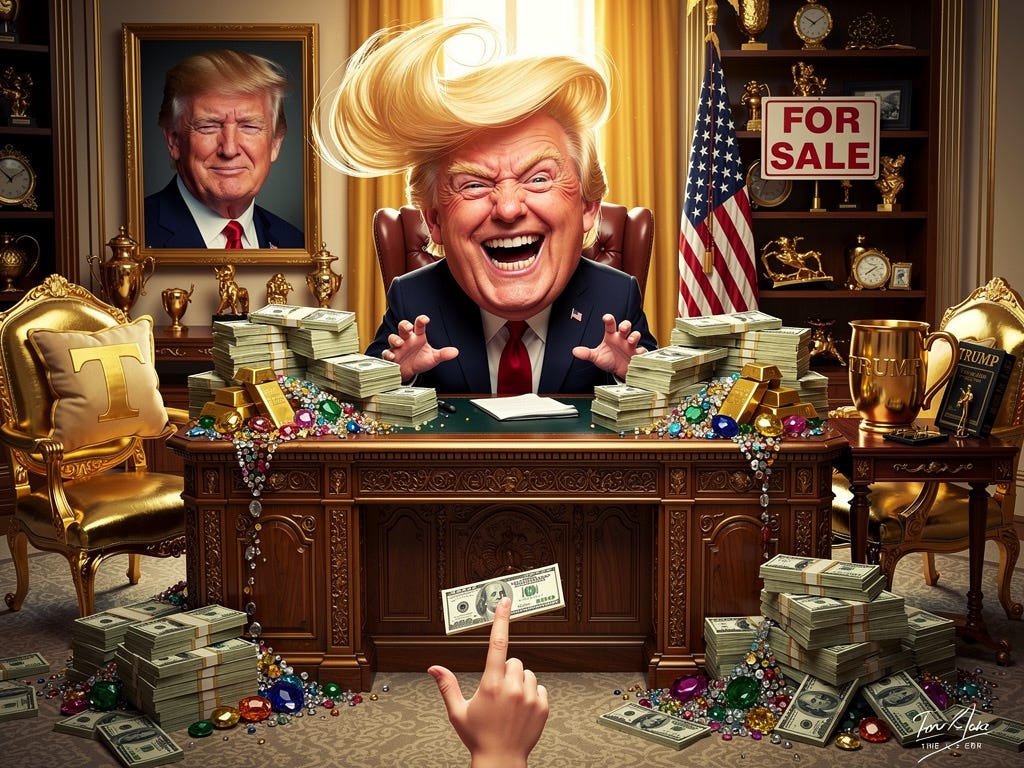
This is a special report. Every claim below is sourced. Where investigations are ongoing or allegations remain unproven, this report says so. Where charges have not been filed, it says that too. The facts are reported as facts. The pattern is the reader’s to assess.
PROLOGUE: THE PRECEDENT
Before the war, there was the hotel.
When Donald Trump was inaugurated in January 2017, he became the first president in the modern era to refuse to divest from his business empire or place his assets in a blind trust. What followed was documented, painstakingly and over years, by the Democratic staff of the House Oversight Committee, using financial records obtained from Trump’s accounting firm, Mazars USA, through a court order that took years of litigation to enforce.
The records, covering just two years of Trump’s first term and only four of his more than 500 business entities, showed that at least 20 foreign governments made payments to Trump-owned properties while he was president — totaling at minimum $7.8 million. China led, with more than $5.5 million flowing through state-owned entities leasing space at Trump Tower and the Trump International Hotels in Washington and Las Vegas. Saudi Arabia spent at least $615,422 at Trump properties during the same period. Qatar spent $465,744. Kuwait, the United Arab Emirates, Malaysia, Turkey, and the Democratic Republic of Congo were among the others. The House Oversight Committee’s Democratic staff noted explicitly that the $7.8 million figure was almost certainly a fraction of the total — the document production was halted before a full accounting was possible, and it covered only two years and four properties out of hundreds. NBC News, CBS News, NPR, and the Associated Press all confirmed the report’s findings.
The Constitution’s Foreign Emoluments Clause prohibits a president from accepting payments from foreign governments without congressional approval. No such approval was sought. Trump had pledged to donate profits from foreign government business to the U.S. Treasury. His organization disclosed individual-year donations of $151,470 in 2017 and $191,000 in 2018, confirmed by NBC News and ABC News. The watchdog Citizens for Responsibility and Ethics in Washington, building on the Oversight Committee’s incomplete data with additional sourcing, estimated the organization donated approximately $448,000 total across all years — a fraction of CREW’s own estimated $13.6 million in total documented foreign payments. (CREW report)
One detail stood out. Saudi Arabia was spending at Trump’s hotels at the same time its Crown Prince, Mohammed bin Salman, was receiving an arms deal from Trump’s administration worth more than $100 billion. Trump signed the deal on his first overseas trip as president — an unprecedented choice of Saudi Arabia as his inaugural foreign destination. When the CIA later concluded that MBS had ordered the murder of journalist Jamal Khashoggi, Trump declined to impose sanctions, publicly casting doubt on the intelligence community’s assessment. The Oversight Committee documented Saudi payments to Trump properties throughout this period. (House Oversight Committee primary, January 4, 2024)
Republicans took control of Congress in January 2023. The incoming chairman worked with Trump’s attorneys to terminate the court-ordered document production. The full accounting was never completed.
That was Term One.
I. THE TRADES
At 6:49 a.m. New York time on Monday, March 23, 2026, something happened in the oil futures market that had no visible cause.
In a single minute — between 6:49 and 6:50 a.m. — roughly 6,200 Brent and West Texas Intermediate futures contracts changed hands. The notional value of those trades was $580 million, according to the Financial Times, which first reported the spike based on Bloomberg data. Trading volumes for Brent and WTI leapt 27 seconds before 6:50 a.m. against an otherwise quiet premarket session. At the same moment, S&P 500 e-Mini futures recorded a sharp isolated jump in volume — approximately 6,000 contracts representing more than $2 billion in notional value, according to market data reviewed by multiple analysts.
At 7:04 a.m. — fifteen minutes after the oil futures spike — President Trump posted on Truth Social that there had been “productive conversations” with Tehran to end the war. Oil prices tumbled. The Dow surged more than 1,000 points. Anyone who had bet on falling oil prices and rising equities in that fifteen-minute window made significant money.
The Financial Times was first. Axios confirmed. CBS News confirmed. NPR confirmed. The BBC conducted its own review of market data and reached the same conclusion.
“It is very difficult to believe these bettors would place that amount of money, moments before an official announcement that would impact oil prices, based on simple chance,” Craig Holman, government watchdog Public Citizen’s lobbyist on ethics and campaign finance, told CBS News.
Stephen Piepgrass, a futures trading specialist at the law firm Troutman Pepper Locke, called the spike sufficient to “raise eyebrows” and to “launch an investigation into what was behind that.”
Paul Krugman, the Nobel Prize-winning economist, went further. In an NPR interview and a subsequent Substack post covered by Fortune, Krugman argued that trading on classified national security information isn’t merely unfair — it’s strategically dangerous. “The strong possibility that somebody in the administration or close to the administration is making money out of insider knowledge of national security decisions — there’s not a really hard line between that and being bribed to reveal information about national security decisions,” he told NPR. “It’s not that different from being a foreign agent.” He used the word “treason.”
Iran’s parliament speaker, Mohammad-Bagher Ghalibaf, denied that any negotiations had taken place, calling Trump’s announcement “fake news” used to “manipulate the financial and oil markets.”
The oil futures spike was not an isolated event. The Guardian reported that eight newly created Polymarket accounts had collectively bet approximately $70,000 on a U.S.-Iran ceasefire before March 31 — positioning them to collect nearly $820,000 if the deal materialized. Separately, six newly created accounts in February had made approximately $1 million by correctly betting that the U.S. would strike Iran before February 28. A New York Times analysis found an unusual surge of more than 150 Polymarket accounts placing bets predicting a U.S. strike on Iran on the Friday before the war began.
Senator Chris Murphy of Connecticut, reviewing a separate report of $1.5 billion in S&P 500 futures purchased five minutes before Trump’s announcement, posted on X: “Who was it? Trump? A family member? A White House staffer? This is corruption. Mind blowing corruption.” (The Hill)
The White House denied any wrongdoing. Spokesperson Kush Desai said in a statement: “All federal employees are subject to government ethics guidelines that prohibit the use of nonpublic information for financial benefit. Any implication that Administration officials are engaged in such activity without evidence is baseless and irresponsible reporting.” White House counsel David Warrington added that “President Trump performs his constitutional duties in an ethically sound manner.” No specific explanation for the pre-announcement trading spike was offered.
No charges have been filed. No federal investigation has been publicly announced.
II. THE WATCHDOG PROBLEM
The agency most directly responsible for investigating suspicious market activity in this kind of case is the Securities and Exchange Commission. Its Enforcement Division director, Margaret Ryan, resigned on March 16, 2026, after six months in the role.
Reuters, which broke the story, reported that Ryan had clashed with SEC chairman Paul Atkins and other senior Republican political appointees over the direction of enforcement — specifically over cases with ties to President Trump and his circle. Two sources familiar with the matter told Reuters that Ryan wanted to be more aggressive in pursuing charges for fraud and misconduct in those cases, and faced resistance. Her resignation email did not explain her departure. She declined to comment when reached by phone.
The SEC confirmed the resignation in a press release. The agency said, in a statement, that enforcement decisions under Atkins were “based on facts, the law, and policy, not on politics.”
The SEC’s departure from aggressive enforcement is not limited to Ryan’s exit. The Axios analysis published March 25 noted that the Trump administration had systematically reduced the capacity of the agencies most capable of investigating financial misconduct tied to official conduct. The Justice Department’s Public Integrity Section — created after Watergate specifically to prosecute corrupt officials — was reduced from 36 lawyers to two, according to reporting by NOTUS, and stripped of its authority to file new cases. A Public Citizen tally found that the administration canceled 159 federal enforcement actions against 166 companies — more than 30 of which had donated to Trump’s inauguration or White House ballroom events.
The result is a documented pattern: suspicious trades occur in the minutes before major presidential announcements. The agencies positioned to investigate them are simultaneously being curtailed. No public federal investigation has been opened into the March 23 trading activity.
III. THE FAMILY BUSINESS
On March 9, 2026 — nine days after the U.S. and Israel launched strikes on Iran — a drone company called Powerus announced it would go public through a merger with Aureus Greenway Holdings, a Nasdaq-listed golf course operator. The announcement identified Donald Trump Jr. and Eric Trump as “notable investors” in Powerus.
The Associated Press, which broke the story, reported that Powerus was founded approximately a year ago by U.S. Army Special Operations veterans and had since acquired three rivals and raised $60 million. The company is pursuing funding from the Pentagon’s “Drone Dominance” program — a $1.1 billion initiative to build up American drone manufacturing capacity. The same administration that created that program had banned Chinese-made drones, eliminating Powerus’s primary foreign competition and creating the market gap the company was formed to fill. (AP via Military.com)
Bloomberg confirmed the details. The Wall Street Journal was first to report the Trump sons’ investment. ABC News added that Eric Trump had also invested separately in Xtend, an Israeli drone maker that opened a U.S. facility in Tampa. Xtend received a multi-million-dollar contract from the Department of War to develop AI-enabled attack drones. ABC News reported that the joint U.S.-Israeli attacks on Iran marked the first time the Pentagon had used one-way attack drones in combat — the category of weapons both Powerus and Xtend are positioned to supply.
Eric Trump’s statement, provided to multiple outlets by the Trump Organization: “I am incredibly proud to invest in companies I believe in. Drones are clearly the wave of the future.”
The drone portfolio extends further. Donald Trump Jr. joined the advisory board of Unusual Machines, a drone parts startup, in November 2024 — immediately after his father’s election. In December 2025, Unusual Machines received a $620 million loan from the Pentagon’s Office of Strategic Capital — the largest loan in that office’s history, according to Military Times. Trump Jr.’s venture capital firm, 1789 Capital, has also taken a major stake in Anduril Industries, a defense company specializing in unmanned combat systems.
Senators Elizabeth Warren and Richard Blumenthal wrote to Defense Secretary Pete Hegseth asking whether the Department of Defense had established any plan to prevent the president’s sons from profiting from defense contracts. According to CNBC, they had not received a response.
Brett Velicovich, Powerus co-founder, addressed the conflict-of-interest question directly when asked by the AP: “There’s no conflict there. Whatever they’re doing, is what they’re doing. Our focus at the company has nothing to do with politics.”
Michael Hedtler-Gaudette, a government ethics expert quoted by ABC News, offered a different assessment: “It’s not likely that President Trump is making decisions on companies bidding for Pentagon contracts. But everyone who is making those decisions is certainly aware of who is involved in those companies. So it is hard to trust the integrity of those decisions.”
No charges have been filed. No federal ethics investigation has been publicly announced.
IV. THE ENVOY
Jared Kushner holds no official government position. He was named to President Trump’s “Board of Peace” on February 19, 2026, and has since participated in Iran nuclear negotiations, Russia-Ukraine talks, and Gaza ceasefire discussions. He met with Oman’s foreign minister in Geneva on February 26 as part of the Iran nuclear track. He was, by multiple accounts, embedded in the highest levels of U.S. diplomacy during the final days before the war began.
At the same time, he has been running Affinity Partners, his private equity firm, which manages assets that had grown to $6.2 billion by the end of 2025 — a nearly 30 percent rise confirmed by Bloomberg through regulatory filings. Approximately 99 percent of those assets belong to non-U.S. investors. The primary backers are sovereign wealth funds from Saudi Arabia, the United Arab Emirates, and Qatar — the same governments Kushner has been engaging as Trump’s self-described volunteer peace envoy. (Daily Beast)
The New York Times reported on March 13, citing five people with direct knowledge, that Kushner had been speaking with potential investors about raising at least $5 billion in fresh capital for Affinity Partners, with Saudi Arabia’s Public Investment Fund among those in discussions for “first look” rights. Axios confirmed the fundraising push. In December 2024, Kushner had publicly told the Invest Like the Best podcast that his firm would “preemptively” halt new fundraising for four years to avoid conflicts. That commitment, the Times reported, appeared to have been abandoned.
On March 19, Senate Finance Committee Ranking Member Ron Wyden and House Oversight Committee Ranking Member Robert Garcia launched a formal congressional investigation, writing simultaneously to the White House and to Affinity Partners directly. The letters demanded Kushner’s foreign travel schedule, records of every foreign government with whom he had discussed U.S. policy, and documentation of what safeguards — if any — existed to separate his government work from his fundraising activities. The Senate Finance Committee published the letter on its official website as a primary document.
Republican Senator Thom Tillis, in a position noted in the Garcia-Wyden letter, raised his own concerns: Witkoff and Kushner “are not subject to Senate confirmation, and they’re not subject to oversight.”
Iran has since indicated it no longer wishes to negotiate with Kushner or Witkoff. One source told NBC News that Tehran would prefer to deal with Vice President JD Vance instead.
Affinity’s chief legal officer, following the congressional probe announcement, said the firm had reversed course on a planned new fundraising vehicle and did not intend to take in additional capital while Kushner was volunteering for the government. The White House dismissed the congressional probe as the “same, tired narrative” Democrats had recycled for years. Spokesperson Anna Kelly said: “Jared is generously volunteering his time to advance the president’s agenda to bring peace to global conflicts — and like the president, he only acts in the best interests of the American public.”
No charges have been filed.
V. THE DOCUMENTS
On March 25, 2026, the House Judiciary Committee’s Democratic staff released details of a January 2023 memorandum produced by former Special Counsel Jack Smith’s office — documents the Justice Department had turned over to the Republican-run committee as part of its investigation into Smith’s conduct.
The memo, obtained and confirmed independently by NBC News, described what Smith’s investigators had concluded about Trump’s motive for retaining hundreds of pages of classified documents at Mar-a-Lago after leaving office in January 2021. The FBI had found, prosecutors wrote, that certain classified documents Trump retained “would be pertinent to certain business interests” — and that this pertinence helped establish motive for why he had kept them.
Among the documents: at least one so sensitive that only six people in the entire U.S. government had authority to review it. Another set was so recklessly handled that it was scanned, stored on a Trump aide’s laptop for nearly two years, and uploaded to a cloud server by unauthorized individuals — practices Smith’s team described as posing “aggravated potential harm to national security.”
The memo also described a June 2022 flight to Trump’s Bedminster golf club in New Jersey. Smith’s team believed Trump had shown a classified map to passengers on that flight. Susie Wiles — then the CEO of Trump’s super PAC, now the White House chief of staff — was aboard, according to a flight manifest included in the Justice Department’s disclosure. The map’s subject matter was redacted; the passengers were not identified beyond Wiles.
Rep. Jamie Raskin of Maryland, the top Democrat on the House Judiciary Committee, wrote to Attorney General Pam Bondi: “This glimpse into the trove of evidence behind the coverup reveals a President of the United States who may have sold out our national security to enrich himself.” (House Judiciary Committee Democrats primary release; The Hill)
Raskin drew a specific line. At the time of the June 2022 Bedminster flight, Trump was entering into partnerships with Saudi-backed LIV Golf and with the Saudi state-linked real estate firm Dar al Arkan. A month after the flight, Trump played golf at Bedminster with Yasir al-Rumayyan — the head of Saudi Arabia’s sovereign wealth fund, the same fund that would go on to invest $2 billion in Jared Kushner’s Affinity Partners. “If this map is related to our military posture in the Middle East,” Raskin wrote, “and it was in fact shown to any foreign official, Saudi or otherwise, that would amount to an unforgiveable betrayal of our men and women in uniform who are currently valiantly fighting in President Trump’s disastrous war against Iran.”
The case was dismissed in 2024 by Judge Aileen Cannon, who ruled that Smith had been improperly appointed as special counsel. Smith remains under a sweeping gag order imposed by Cannon at Trump’s request, barring him from sharing information with Congress. The Justice Department called Raskin’s characterization “baseless” and described the memo as containing “salacious and untrue claims.” White House spokesperson Abigail Jackson said Trump “did nothing wrong.”
No charges are pending. The full Volume II of Smith’s final report — which covers the classified documents case — remains suppressed.
EPILOGUE: THE LEDGER
When Donald Trump was inaugurated for his second term in January 2025, his net worth was estimated at approximately $3.9 billion by Forbes. Three days before the inauguration, he launched a meme coin bearing his name — $TRUMP — with 80 percent of the supply controlled by Trump-affiliated entities. Within hours, the coin’s aggregate market value exceeded $27 billion. A forensic analysis by blockchain firm Chainalysis, commissioned by the New York Times, concluded that 813,294 wallets lost approximately $2 billion trading the coin while Trump’s company and affiliated partners made roughly $100 million in trading fees. (Fortune; NBC News) Two days after $TRUMP launched, Melania Trump launched $MELANIA.
By September 2025, Forbes estimated Trump’s net worth at $7.3 billion — an increase of approximately $3.4 billion in less than a year in office. Bloomberg, reporting on January 20, 2026 — the one-year mark of his second term — confirmed that digital assets now made up roughly one-fifth of the Trump family’s total fortune, with $1.4 billion in crypto gains in the prior year alone. France 24, citing Forbes estimates, reported that Trump himself had made approximately $2.4 billion from cryptocurrencies since 2024.
The $TRUMP meme coin had a further feature with no historical parallel. In April 2025, the top 220 holders of the coin were offered dinner with the president. The top 25 received a VIP White House tour. Following the announcement, the coin’s price jumped more than 50 percent. A subsequent gala expanded eligibility to 297 holders, with the top 29 invited to a “special reception” with their “FAVORITE PRESIDENT.” Fortune reported on the second gala in March 2026. Analysis found that leaked information about the first promotion had allowed certain traders to bet on the coin before the announcement was public.
Crypto firms donated $18 million to Trump’s inauguration fund, according to a tally by Fortune. Justin Sun, the crypto billionaire who is the largest known investor in World Liberty Financial — the Trump family’s DeFi project, co-founded in part with Zach Witkoff, son of peace envoy Steve Witkoff — had been the subject of a 2023 SEC fraud investigation. The Trump-era SEC settled the charges against one of Sun’s companies for $10 million, without admission of wrongdoing, and dropped the remaining charges entirely. The settlement was negotiated during the period when SEC Enforcement Director Margaret Ryan was clashing with her superiors over the handling of cases with ties to the president’s circle.
The Christian Science Monitor, in an April 2026 analysis, noted that Trump’s personal fortune — now estimated at $6.5 billion, up $1.4 billion from March 2025 — had grown substantially during his second term. “There is no historical parallel for this,” Will Ragland, vice president of research at the Center for American Progress, told France 24. “Nothing comes close.” Ragland noted that while former presidents from both parties had gone to considerable lengths to avoid conflicts of interest — Jimmy Carter placing his peanut farm in a blind trust; both Bush presidencies establishing strict separation between business and policy — Trump had moved in the opposite direction with each successive year in public life.
What remains is a question about mechanism, not motive. The trades in the oil futures market on the morning of March 23 were executed by parties still unidentified. The classified documents described in the Smith memo as pertinent to Trump’s business interests have not been publicly disclosed. The full record of Kushner’s conversations with Gulf sovereign wealth funds during the period he was simultaneously serving as a peace envoy has not been produced to Congress. The Senate Finance Committee’s document request deadline — April 2, 2026 — has now passed.
The White House position, as stated across multiple spokespeople and multiple inquiries: the president performs his duties ethically, his family acts in the public interest, and allegations to the contrary are baseless partisan attacks.
The facts in this report are not allegations. They are documented. Each is sourced above.
The pattern is the reader’s to assess.
(As of publication, neither Affinity Partners nor the White House had produced the requested documents.)
“Whenever the people are well informed, they can be trusted with their own government.” — Thomas Jefferson, 1789
ADDITIONAL SOURCES
(Sources not already linked within the body of the story)
Prologue
House Oversight Committee Democrats, Raskin letter to Trump (January 12, 2024): demand for return of funds; full $7,886,072 figure
II. The Watchdog Problem
IBTimes UK (March 23, 2026): Ryan’s background, unconventional appointment, acting director named
IV. The Envoy
House Oversight letter to Affinity Partners (March 19, 2026): Primary PDF — full text of document request; April 2, 2026 deadline
IBTimes UK (March 26, 2026): Tillis quote; Geneva meeting details; Oman News Agency confirmation
Rudy, I don't know how we deserve you - I'm convinced we don't - but you are amazing. Thank you. May you find Portillo's has come to Paris one day soon. 🙏🏽