
The Rest of the World Report | The Children
Special Report | Saturday, April 11, 2026

Special editions replace the regular morning or evening edition. All sources labeled. Translator’s notes on every story.
A NOTE BEFORE YOU READ
This edition contains documented accounts of violence against children. The events described are not allegations. They are the findings of independent investigations, United Nations bodies, Human Rights Watch, Amnesty International, Forensic Architecture, and multiple wire services. They belong in the public record. We are publishing them here.
HIND
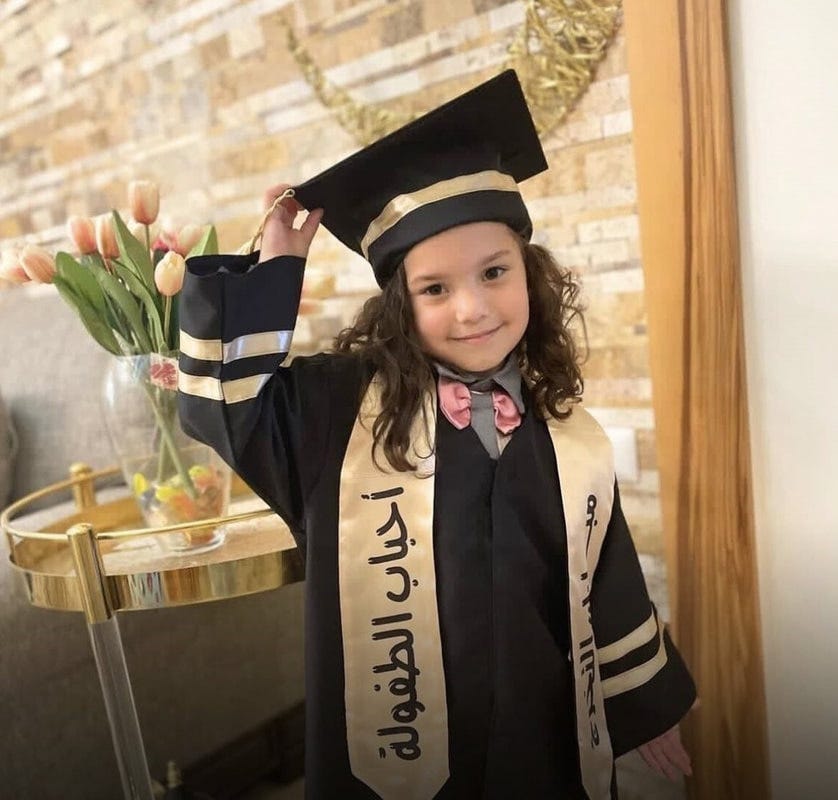

Her name was Hind Rajab. She was six years old.
On the morning of January 29, 2024, her uncle Bashar packed her into the family car along with his wife and their four children, including fifteen-year-old Layan, Hind’s cousin. They were trying to reach a designated safe zone in northern Gaza City. They did not make it a quarter of a mile.
Around one in the afternoon, Layan called a relative. She said they were surrounded. She said the Israeli army had opened fire. She said everyone in the car except her and Hind was dead.
A dispatcher at the Palestine Red Crescent Society reached Layan at around two-thirty. Sixty-four gunshots are audible over six seconds in the recording of that call, according to Earshot, a nonprofit that investigates incidents using audio evidence. Then Layan went quiet. She was fifteen years old.
Hind was left alone in the back seat. She was surrounded by the bodies of her uncle, her aunt, and her three cousins. Her mouth was bleeding. Her mother, Wissam Hamada, who had fled on foot with her older children, was patched into the call. Hind told her not to worry about the blood — she didn’t want to make more work for her mother. She said she would wipe it with her sleeve.
For three and a half hours, she stayed on the line. The Palestine Red Crescent Society worked through the Gaza Health Ministry and COGAT — an arm of the Israeli Defense Ministry that coordinates safe passage for medical vehicles — to secure a route for an ambulance crew. According to messages reviewed by the Washington Post, COGAT provided a route map to the PRCS at 5:40 p.m. COGAT’s own coordinator later confirmed to the Post that it had “coordinated everything, including the ambulance that wanted to go and find Hind.” The IDF simultaneously denied that any coordination had taken place. The ambulance drove toward her, sirens on, marked as a medical vehicle.
The ambulance never arrived. Both paramedics — Yousef Zeino and Ahmed al-Madhoun — were killed when a tank shell struck their vehicle directly.
Twelve days later, when the Israeli military withdrew and Palestinian civil defense crews could finally reach the area, they found Hind’s body in the car. They found the paramedics in the ambulance fifty metres away.
An investigation by Forensic Architecture and Earshot, conducted in collaboration with Al Jazeera’s Fault Lines and subsequently presented to the United States House of Representatives by Congresswoman Rashida Tlaib, established that an Israeli tank had fired on the family car from a distance of between thirteen and twenty-three metres. The car contained 335 bullet holes. A Washington Post investigation using satellite imagery, contemporaneous dispatcher recordings, and more than a dozen independent military, satellite, munitions, and audio experts confirmed that Israeli armored vehicles were present in the area, and that the damage to the ambulance was consistent with an Israeli tank round.
The IDF initially denied its forces were present. It later said the bullet holes resulted from crossfire between Israeli troops and Palestinian fighters. A March 2026 investigation by the campaign group Avaaz found substantial evidence that the attack on the ambulance was a deliberate double-tap strike — a tactic in which a second attack is directed at the same location specifically to kill survivors of the initial strike and the first responders arriving to help them. The ambulance had received a route from COGAT. Its sirens were on. It was marked as a medical vehicle. Avaaz concluded the assault “points to lethal targeting.”
The specific unit responsible has since been identified by Al Jazeera and the Hind Rajab Foundation as the “Vampire Empire” company of the 401st Armored Brigade. A criminal complaint has been filed at the International Criminal Court.
The September 2025 UN Commission of Inquiry cited Hind Rajab by name in its findings on the direct targeting of children in Gaza.
No Israeli soldier has been charged.
NOT THE EXCEPTION
Hind Rajab’s name reached the world. Most do not.
Between October 7, 2023, and January 15, 2025, children made up at least 18,000 of the 46,707 Palestinians killed in Gaza, according to figures from the Gaza Health Ministry. Both numbers are likely undercounts — thousands of bodies remain beneath the rubble of buildings that have not been excavated. Most children have been killed by direct military strikes.
In March 2024, Philippe Lazzarini, the Commissioner-General of UNRWA, stated that more children had been killed in Gaza in four months than in all global conflicts in the previous four years combined. That was fourteen months before this edition went to press.
Between October 2023 and December 2024, Israeli strikes across Lebanon killed more than 4,000 people, including more than 240 children, according to Human Rights Watch. The United Nations verified the killing and maiming of 541 children by Israeli forces in Lebanon over the course of 2024 alone.
These are not disputed figures. They come from UN bodies, established human rights organizations, and government health ministries. They have been entered into the record of multiple international legal proceedings. They describe something that has been happening, in documented form, for more than thirty years.
THE MACHINE
To understand how Hind Rajab died, it helps to understand the system that was operating when she did.
In the first weeks of the current Gaza war, the Israeli military deployed an AI-powered targeting system called Lavender. According to testimony from six anonymous Israeli intelligence officers — all of whom served during the war and spoke to the Israeli investigative publications +972 Magazine and Local Call — Lavender was used to generate a kill list of up to 37,000 Palestinians flagged as suspected Hamas or Palestinian Islamic Jihad members. The Guardian independently corroborated the core findings. Human Rights Watch published a separate assessment confirming Lavender’s existence and function.
The system carried an acknowledged error rate of approximately ten percent. That figure was not treated as a problem requiring a pause. Sources told +972 that it was treated as a statistically acceptable loss — one in ten targets might be a civilian or a person with no meaningful militant role. The error rate was not a regrettable malfunction. It was a built-in tolerance, a cost-benefit calculation in which the cost was human life.
The speed was the point. Lavender could assess and flag a target in twenty seconds. Human review in that window typically consisted of verifying that the name belonged to a man. The IDF acknowledged the existence of a tool matching Lavender’s description in general terms, calling it “a database whose purpose is to cross-reference intelligence sources.”
A companion system called “Where’s Daddy?” — also reported by +972 and Local Call and corroborated by The Guardian — was designed specifically to locate targets when they were at home with their families at night. The operational logic: men are easier to find at home than in the field. The human consequence: the strikes were timed for when children were most likely to be present in the same building.
Sources told +972 that in the first weeks of the war, the army established that killing up to fifteen or twenty civilians was an acceptable cost for eliminating each junior Hamas operative Lavender identified. For a senior commander, the authorized civilian toll rose above one hundred. One source said the principle of proportionality under international law had effectively ceased to exist in that period. The authorized ratios were a policy choice — a decision made by human commanders about how many civilian lives, including children’s lives, constituted an acceptable price.
UN Secretary-General António Guterres said he was “deeply troubled” by the reports. Francesca Albanese, the UN Special Rapporteur on the situation of human rights in the Palestinian territories occupied since 1967, stated that if the reporting was accurate, many Israeli strikes in Gaza would constitute the war crime of launching disproportionate attacks.
Lavender did not create the pattern this edition documents. It industrialized it.
PART ONE: LEBANON, 1990s — THE TOYS
The documented record of Israel using civilian objects as weapons in areas where children were present begins, at least in the public record, in southern Lebanon in the 1990s.
In 1997, Lebanese newspaper L’Orient-Le Jour reported on a series of incidents in which children in southern Lebanese villages had been killed or maimed by explosive devices disguised as everyday objects — toys, flashlights, small plastic vehicles. A nine-year-old girl lost her right hand when a plastic jeep she found near her village exploded. Another child sustained severe burns from a booby-trapped flashlight. A girl was killed after calling out to her family that she had found a doll. A UNIFIL officer confirmed to the AFP at the time that the objects were primarily dropped by helicopter. “It can be a toy or have the shape of an ordinary stone,” the officer said, speaking anonymously.
In 1998, Lebanon’s Permanent Mission to the United Nations sent a formal letter to the Secretary-General — on record at the UN’s UNISPAL archive — stating that Israeli fighter planes had “attempted to kill children by dropping thousands of booby-trapped toys on Lebanese villages and towns,” and that booby-trapped toys had been dropped on the town of Nabatiyah, “killing and injuring children and permanently disfiguring others.”
Israel denied the allegations, calling them “despicable.”
In 2000, a report by the United Kingdom’s House of Commons Foreign Affairs Committee — a parliamentary body, not an advocacy group — warned of the dangers of unexploded ordnance in southern Lebanon and specifically referenced “booby-trapped toys, allegedly dropped by the Israeli airforce near Lebanese villages adjacent to the so-called security zone.” The UK government’s own Foreign and Commonwealth Office submitted a separate memorandum to the Committee on the landmine situation in south Lebanon that same year.
The allegation was made by Lebanon to the UN Secretary-General. It was noted in the parliamentary record of a NATO ally. It was corroborated by a UNIFIL officer to a wire service. No investigation was opened. No accountability followed.
PART TWO: LEBANON, 2006 — THE CLUSTER BOMBS
In the summer of 2006, during the 34-day war between Israel and Hezbollah, the Israeli military fired approximately 1,800 cluster rockets containing over 1.2 million submunitions into southern Lebanon. Human Rights Watch deployed researchers to the ground immediately after the ceasefire and documented more than fifty cluster munition strike sites across forty towns and villages. Approximately ninety percent of the submunitions were fired in the final seventy-two hours of the conflict — the period between the UN Security Council’s unanimous passage of Resolution 1701 on August 11, 2006, calling for a full cessation of hostilities, and the ceasefire taking effect on August 14.
David Shearer, the UN’s humanitarian coordinator in Lebanon, called this “outrageous,” saying it was “extraordinary that they were fired off in the last hours of the war into areas where civilian populations were known to be going.”
An Israeli army commander told the Israeli newspaper Haaretz: “We covered entire villages with cluster bombs, what we did there was crazy and monstrous.” To compensate for the rockets’ imprecision, the order was to flood the areas with submunitions.
The submunitions had a failure rate of between thirty and forty percent. They did not explode on impact. They landed in gardens, on rooftops, in olive orchards, inside houses, on playgrounds. Chris Clark, Programme Manager of the UN Mine Action Coordination Centre for South Lebanon, described them at the time: “They seem innocuous, especially to the curious mind of a child. They’re small, they easily conceal themselves amongst all the rubble or the debris of the bombing.”
Human Rights Watch documented that as of January 2008, cluster munition duds had caused at least 192 civilian casualties since the ceasefire. Sixty-one of those 192 were children under eighteen.
The United States State Department concluded in a preliminary investigation that Israel may have breached its agreements with Washington governing the use of US-supplied cluster munitions. The moratorium was noted. It was not enforced. Israel refused to provide the UN Mine Action Coordination Centre with grid coordinates of cluster bomb strike sites to assist clearance operations. The UN’s Clark said it had received “nothing” from Israel.
Unexploded submunitions from the 2006 conflict were still killing people in Lebanon years later. In November 2025, The Guardian published photo evidence — reviewed by six independent arms experts — that Israel had again used cluster munitions in Lebanon during its 2024–2025 military campaign.
PART THREE: THE CURRENT WAR — DOCUMENTED INCIDENTS
The following are not representative samples. They are specific documented incidents, each independently investigated, each with formal findings on file.
Al-Maghazi, Gaza, April 16, 2024. Amnesty International documented that fifteen civilians were killed in a deliberate Israeli air strike on Market Street in Al-Maghazi refugee camp in central Gaza. Ten of the fifteen were children. They had been playing around a football table. Amnesty International described the strike as deliberate.
Khadija Girls’ School, Deir al-Balah, July 27, 2024. Human Rights Watch investigated three Israeli airstrikes on the Khadija girls’ school, carried out over approximately three hours beginning shortly before noon. The school had sheltered around four thousand displaced people for months and was connected to a nearby hospital. At least fifteen people were killed. Human Rights Watch confirmed that US-supplied GBU-39 Small Diameter Bombs were used. Human Rights Watch found no evidence of a military target at the school. Israeli authorities provided no information about the intended target or precautions taken.
Al-Zeitoun C School, Gaza City, September 21, 2024. Human Rights Watch documented an Israeli airstrike on Al-Zeitoun C school in which at least thirty-four displaced Palestinians were killed, including at least twenty-one children. US-supplied munitions were again confirmed at the site. Human Rights Watch found no evidence of a military target.
Younine, Lebanon, September–November 2024. Human Rights Watch documented two separate Israeli strikes on the northeastern Lebanese town of Younine. The first, on September 25, killed twenty-three people. The second, on November 1, killed ten more. Fifteen of the thirty-three dead were children. Human Rights Watch found no evidence of military activity at either site. Weapon remnants confirmed the use of US-supplied Mk-80 series bombs. Human Rights Watch described both strikes as apparent indiscriminate attacks on civilians.
Sixteen-year-old Yousef Abdelkader survived the first strike. His parents, siblings, grandfather, and two uncles’ families were killed. “My mom, grandpa, and others were still standing just outside the door talking to the rest of the family,” he told Human Rights Watch, “when I heard the sound of a plane, and I saw the rocket fall.”
Ein El-Hilweh, Lebanon, November 2025. An Israeli drone strike on the Ein El-Hilweh Palestinian refugee camp near Sidon killed at least thirteen civilians, eight of them children, and injured at least six others. The UN Office of the High Commissioner for Human Rights documented that all fatalities confirmed in its investigation were civilians. Israel said it had targeted a Hamas training compound. It provided no further clarification. The UN Special Rapporteur on Summary Executions described the attack as part of a pattern of near-daily Israeli strikes in Lebanon since the November 2024 ceasefire.
The School Targeting Programme. The Israeli publications +972 Magazine and Local Call reported in July 2024, citing military sources, that the Israeli military had established a dedicated strike cell to systematically identify schools as “centers of gravity” for bombing. Sources described double-tap strikes — second attacks on the same location designed to kill survivors of the initial strike and the first responders arriving to help — as having become particularly common when bombing schools in Gaza. Human Rights Watch documented that nearly all of Gaza’s 564 schools sustained damage during the war, with 92 percent requiring full reconstruction or major repairs. Nearly one million displaced Palestinians sought shelter in those schools.
The Pager Attack, September 2024. On September 17, 2024, thousands of pagers simultaneously exploded across Lebanon and parts of Syria. At least twelve people were killed, including two children and two health workers. More than 2,800 were injured. US officials and former Israeli officials stated that Israel was responsible. Human Rights Watch noted that customary international humanitarian law explicitly prohibits booby traps — defined as objects that civilians are likely to be attracted to or that are associated with normal civilian daily use — precisely because of the harm to non-combatants such weapons inevitably produce. The pager attack killed a nine-year-old girl and an eleven-year-old boy.
PART FOUR: WHAT THE INSTITUTIONS HAVE FOUND
These are formal findings of international legal and investigative bodies. They are not advocacy positions.
International Criminal Court, November 2024. The ICC issued arrest warrants for Israeli Prime Minister Benjamin Netanyahu and former Defense Minister Yoav Gallant for war crimes and crimes against humanity in Gaza. The warrants cover the period from October 7, 2023, to May 20, 2024.
International Court of Justice, 2024. The ICJ issued binding provisional measures in January, March, and May 2024, ordering Israel to enable humanitarian access, prevent genocide against Palestinians in Gaza, and ensure access for fact-finding bodies. The UN Commission of Inquiry found that Israel “flagrantly disregarded” all three orders.
Amnesty International, December 2024. Amnesty International concluded that Israel has committed and is continuing to commit genocide against Palestinians in the occupied Gaza Strip. Amnesty International’s report reviewed fifteen investigated airstrikes and identified twenty-two statements by senior Israeli officials that appeared to call for or justify genocidal acts, which Amnesty International described as direct evidence of genocidal intent. Amnesty International’s Secretary General Agnès Callamard stated: “Our research reveals that Israel has persisted in committing genocidal acts, fully aware of the irreparable harm it was inflicting on Palestinians in Gaza.”
UN Special Rapporteur Francesca Albanese, March 2024. Francesca Albanese, the UN Special Rapporteur on the situation of human rights in the Palestinian territories occupied since 1967, reported to the UN Human Rights Council that there were reasonable grounds to believe that Israel had committed acts amounting to genocide in Gaza. Her report found that Israel’s executive and military leadership had “intentionally distorted foundational rules of international humanitarian law — distinction, proportionality and precaution — in an attempt to legitimize genocidal violence against the Palestinian people.” Albanese described this as “humanitarian camouflage.” The United States sanctioned Albanese in July 2025 in response to her work. She was reconfirmed in her mandate by the Human Rights Council in April 2025.
UN Commission of Inquiry, September 2025. The Independent International Commission of Inquiry on the Occupied Palestinian Territory — a two-year investigation covering October 7, 2023, through July 31, 2025 — concluded that Israel is responsible for the commission of genocide in Gaza. The Commission, chaired by former UN High Commissioner for Human Rights Navi Pillay, found Israel guilty of four of the five acts specified in the 1948 Genocide Convention: killing Palestinians, causing serious bodily and mental harm, deliberately inflicting conditions of life calculated to bring about physical destruction, and imposing measures intended to prevent births. The Commission specifically reviewed the “direct targeting” of children and found that genocidal intent was “the only reasonable inference” that could be drawn from the totality of the evidence.
The Commission also found that Israel refused the entry of infant formula and special milk for newborns into Gaza, which it described as resulting in the starvation of newborn and young infants, and called “especially powerful evidence of an intention to destroy the population.”
The Commission called for genocide charges to be added to the ICC arrest warrants for Israeli leaders. Israel’s ambassador to the UN in Geneva called the report a “libelous rant.” The Israeli Foreign Ministry called for the Commission to be abolished.
THE PATTERN
The record this edition documents spans three decades, two countries, and five distinct categories of conduct: booby-trapped objects designed to attract and kill civilians in areas populated by children; indiscriminate weapons with predictable and documented child casualty rates; specific strikes on civilian locations sheltering children with no military target identified by any investigating body; an AI targeting architecture that established mass civilian death — including children’s deaths — as a numerically authorized byproduct; and the weaponization of food, shelter, and medical care.
Each of these, taken alone, has been documented, investigated, and formally reported. Together they constitute a pattern that multiple UN bodies, two of the world’s leading human rights organizations, and the prosecutor of the International Criminal Court have found sufficient to establish criminal liability at the highest levels of the Israeli government.
The pattern has also produced, across thirty years, no accountability. No criminal conviction. No suspended arms transfer from the United States that held. No mechanism that stopped it.
What changed between the toys dropped in Lebanese villages in 1997 and the algorithm running in Gaza in 2024 is not the logic. It is the scale.
RITAJ
Her name was Ritaj Rihan. She was nine years old.
On the morning of April 9, 2026 — two days before this edition was published — her father dropped her at the school gate in Beit Lahia, in northern Gaza. She was talking excitedly about her uncle’s upcoming wedding. What dress she would wear. How she would style her hair.
The school was a tent. The classroom held forty-four children. Ritaj was a third-grade student. She was sitting at her desk when she was shot in the neck. The shot came from the east, in the direction of Israeli positions. Forty-four other children watched her fall.
Her teacher, Ayman Rihan, heard the screaming and ran to the tent. He found Ritaj lying face down, blood coming from her mouth. She was taken to a clinic in Jabalia, where she died.
The Israeli military had no immediate comment.
Gaza was under ceasefire when Ritaj Rihan was killed. Hind Rajab was killed in January 2024, during active full-scale war — nearly a year before the first ceasefire took effect. Between them — between a six-year-old left alone in a bullet-riddled car during wartime, and a nine-year-old shot at her desk during a ceasefire — more than 18,000 children were killed in Gaza. Most of them have no article. Most of them have no name in any Western newspaper. Most of them were simply part of the count.
The pattern documented in this edition did not begin with Hind. It did not end with Ritaj. The Israeli military has not been held accountable for either killing. It has not been held accountable for any of what is documented here.
That is also part of the record.
🌍 TRANSLATOR’S NOTE
The killing of Hind Rajab was covered internationally in a way it was not covered in the United States. The French press — Le Monde, Libération, France 24 — reported the Forensic Architecture findings in detail when they were published in June 2024. The BBC ran the Washington Post investigation. The Guardian corroborated the Lavender findings independently. Al Jazeera has dedicated sustained investigative resources to the case, including a full documentary. The Irish Times covered the Forensic Architecture presentation to the US Congress.
What was notable about American coverage was an exchange that became a case study in European media commentary on US press performance: when student protesters renamed Hamilton Hall at Columbia University “Hind’s Hall” in her honor, a CNN anchor explained to viewers that “Hind is a reference to a woman who was killed in Gaza.” Hind Rajab was six years old. The adultification of her — the refusal to say “child” — was noted by press critics across Europe and the Middle East as emblematic of a structural reluctance in American media to name what was happening to Palestinian children.
The broader pattern documented in this edition — the cluster munitions, the school strikes, the Lavender system, the UN Commission genocide finding — has received extensive coverage in European and international press. It has received notably less sustained attention in American mainstream outlets, where individual incidents are sometimes reported but rarely connected into the documented pattern that international and UN investigations have established.
The gap between what the international record contains and what American audiences have been told about it is itself part of this story.
🇺🇸 WHAT AMERICAN READERS NEED TO KNOW
The weapons that killed Hind Rajab were American-made or American-supplied. The GBU-39 Small Diameter Bombs used in the Khadija and Al-Zeitoun school strikes are American munitions. The Mk-80 series bombs used in the Younine strikes in Lebanon are American munitions. The cluster munitions Israel fired into southern Lebanon in 2006 — which killed and maimed children for years after the ceasefire — were in part American-supplied. The US State Department found at the time that Israel may have violated the terms of their use.
American military aid to Israel has continued throughout the period documented in this edition. American diplomatic support has included vetoing or abstaining on UN Security Council resolutions that would have enforced the ICJ’s binding provisional measures. The United States has not conditioned arms transfers on compliance with those measures. It has not enforced its own laws — including the Leahy Law, which prohibits US military assistance to foreign security forces credibly implicated in gross human rights violations — in relation to the units documented in this edition.
This is not a question of what American readers think about the conflict. It is a question of what they are paying for, and what has been done in their name.
The UN Commission of Inquiry stated in September 2025 that all states are under a legal obligation to use all means reasonably available to them to stop the genocide in Gaza. The United States is a state. It has means available to it that no other country on earth possesses.
Hind Rajab’s mother, Wissam Hamada, said after her daughter’s death: “How many more mothers are you waiting to feel this pain? How many more children do you want to get killed?”
That question has not been answered. It has not, in any official American venue, been seriously asked.
“Whenever the people are well informed, they can be trusted with their own government.” — Thomas Jefferson, 1789
Sources: Middle East Eye (UK, pro-Palestinian editorial lean — Lebanon booby-trap history, 1990s–2024 pattern, confirmed this session); L’Orient Today (Lebanon, independent — cluster munitions 2006 and 2024 context, confirmed this session); UN UNISPAL (primary source — Lebanon’s 1998 formal letter to UN Secretary-General, confirmed this session); UK House of Commons Foreign Affairs Committee, 2000 (primary source — parliamentary reference to booby-trapped toys, confirmed this session); Human Rights Watch — Flooding South Lebanon (cluster munitions 2006, full field investigation, confirmed this session); Human Rights Watch — Civilian Casualties Lebanon (2006 casualty analysis including 61 children, confirmed this session); Human Rights Watch — School Strikes (Khadija and Al-Zeitoun C documented strikes, US munitions confirmed, confirmed this session); Human Rights Watch — Younine (Lebanon 2024 strikes, 15 children killed, confirmed this session); Human Rights Watch — Pager Attack (IHL booby-trap prohibition finding, confirmed this session); Human Rights Watch — Lebanon Hostilities (240+ children killed in Lebanon, confirmed this session); Amnesty International — Genocide Finding (December 2024, confirmed this session); Amnesty International — Al-Maghazi Strike Investigation (10 children aged 4–15 killed, foosball table, war crimes finding, confirmed this session); OHCHR — UN Commission Genocide Finding (September 2025, primary source, confirmed this session); OHCHR — Francesca Albanese March 2024 Report (Special Rapporteur genocide finding, confirmed this session); OHCHR — Ein El-Hilweh (November 2025, 8 children killed, confirmed this session); OHCHR — UN Special Rapporteur Lebanon (pattern finding, confirmed this session); Washington Post — Hind Rajab Investigation (centre-left, Tier 2 — satellite imagery, COGAT route map, expert analysis, confirmed this session); Forensic Architecture — Killing of Hind Rajab (independent investigative body — tank position, bullet analysis, confirmed this session); Earshot — The Killing of Layan Hamada and Hind Rajab (independent audio ballistic analysis — 62 gunshots in 6 seconds, firing rate consistent with Israeli army weaponry, tank positioned 13–23 metres from car, confirmed this session); Al Jazeera — Hind Rajab Documentary (Qatar, state-funded/editorially independent — unit identification, Vampire Empire, confirmed this session); Al Jazeera — Double Tap (March 2026, Avaaz findings on ambulance strike, confirmed this session); +972 Magazine — Lavender (Israeli investigative outlet — primary reporting on Lavender and Where’s Daddy, six anonymous serving intelligence officers, confirmed this session); Human Rights Watch — Digital Tools (Lavender/Gospel/Where’s Daddy independent corroboration, confirmed this session); UN News — Children Malnutrition (151 children dead from malnutrition, confirmed this session); UN Special Committee Israeli Practices Report (541 children killed and maimed in Lebanon 2024, UN verified, confirmed this session); CJPME Factsheet — Cluster Munitions (Haaretz commander quote attributed via CJPME citing Haaretz; US State Department finding, confirmed this session); Reuters/Al-Monitor — Maghazi April 2026 (wire service — April 6 2026 school strike, confirmed this session); Reuters/Antiwar — Ritaj Rihan (wire service — Ritaj Rihan killing April 9 2026, father’s quote, confirmed this session); TRT World — Ritaj Rihan (Gaza Education Ministry statement, confirmed this session); Xinhua — Ritaj Rihan (teacher testimony, confirmed this session)