
The Rest of the World Report
Morning Edition | Day 7 of the US-Israel War on Iran | Friday, March 6, 2026


What the international press is covering that American audiences may not be seeing.
THE NUMBERS (as of 12:00 PM Paris time — situation remains fluid)
Israeli strikes to date: 2,500+ strikes, 6,000+ weapons deployed (IDF) US B-2 bombers overnight: Dozens of 2,000 lb “penetrator” bombs on deeply buried ballistic missile facilities (CENTCOM) Strait of Hormuz: Effectively closed. Oil prices up 20% since Day 1. War cost to the US: $3.7 billion for the first 100 hours ($891 million/day), per CSIS — $3.5 billion of it unbudgeted
WHAT THE WORLD IS SAYING
1. 181 Children Dead — UNICEF Releases Full Count 📍 Source: UNICEF press release, Amman — UN agency, international
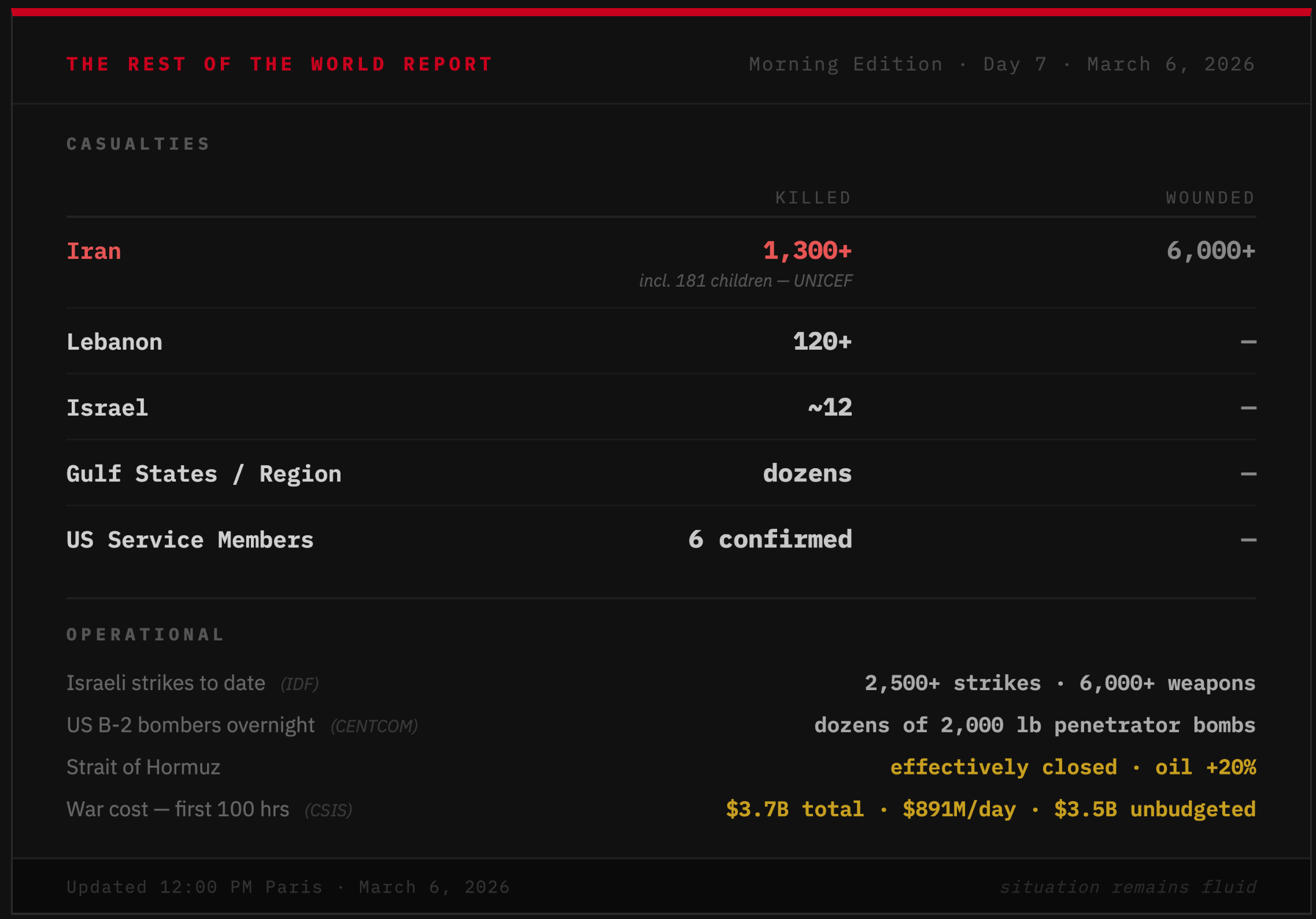
UNICEF confirmed this morning that approximately 180 children have been killed in Iran since the conflict began. Among them: 168 girls aged 7–12, killed when a strike hit the Shajareh Tayyebeh girls’ elementary school in Minab, in southern Iran — on the first day of the war, while classes were in session. Twelve more children died in strikes on schools across five other locations in Iran.
What American readers need to know: The Minab school strike has become an internationally defining image of this war — the equivalent of what Mariupol’s maternity hospital was to the Ukraine war. It is being cited by every human rights body, every UN statement, and virtually every non-US outlet as a central moral reference point. The UN Human Rights Chief called for a “prompt, impartial, and thorough investigation” and said the onus is on the forces that carried out the attack to investigate. It is not leading US coverage in the same way. A note on the school’s location: Wikipedia, citing the New York Times, reports it was less than 60 meters from a large IRGC naval base — a fact that US officials will likely cite. International law does not permit strikes on civilian schools regardless of proximity to military assets.
2. Iran Is Firing Cluster Munitions at Israeli Cities 📍 Source: Haaretz (Israel), Times of Israel, IDF confirmed statements, OSINT Technical (open-source munitions tracking)
Iran has fired at least six ballistic missiles armed with cluster bomb warheads at Israel since the war began — a pattern Haaretz reports Israel’s defense establishment now considers a deliberate trend expected to continue. The warhead opens mid-descent, scattering between 24 and 80 submunitions, each carrying roughly 2.5 kg of explosives, across a radius of up to 8 kilometers. On March 3, submunitions from one of these missiles struck multiple locations in central Israel, wounding 12 people. Iran previously used the same Khorramshahr-4 cluster warhead design during the June 2025 twelve-day war.
Cluster munitions are particularly dangerous because not all submunitions explode on impact — they can lie dormant on the ground, effectively acting as landmines for civilians who encounter them later. The IDF Home Front Command has warned Israeli civilians not to approach any missile debris.
What American readers need to know: Iran is not a signatory to the 2008 Convention on Cluster Munitions, which bans their use. Neither is the United States or Israel — a fact that significantly complicates any Western moral argument on this point. The US supplied cluster munitions to Ukraine, and Israel used them extensively in Lebanon in 2006, drawing international condemnation. The international press is covering Iran’s use directly and without equivocation, but the broader hypocrisy question is also being raised. This story meets our sourcing standard: it is IDF-confirmed, independently documented via open-source footage, and reported across multiple outlets.
3. Tehran Takes Its Heaviest Bombardment Yet — Day 7 Surge 📍 Source: Al Jazeera (Qatar, independent), correspondent Tohid Asadi reporting from Tehran
Al Jazeera’s team on the ground in Tehran described overnight bombing as the most intense of the entire war. Strikes hit areas near Pasteur Street — where key Iranian government institutions are located — the vicinity of Tehran University, and residential neighborhoods. A military academy was struck while a journalist from Iranian state broadcasting was reporting live nearby. CENTCOM confirmed US B-2 stealth bombers dropped dozens of 2,000 lb “penetrator” bombs targeting deeply buried ballistic missile launchers, and also struck what it described as Iran’s equivalent of Space Command. Defense Secretary Hegseth, standing alongside the Chairman of the Joint Chiefs, warned: “If you think you’ve seen something, just wait.”
What American readers need to know: The international press is framing Day 7 not as a turning point but as an escalation without a stated end condition. Al Jazeera’s correspondent noted that Tehran civilians are asking a question US officials haven’t publicly answered: what does “winning” look like, and when does the bombing stop?
4. The Interceptor Math Is Getting Alarming — and the Pentagon Knows It 📍 Source: France 24, Al Jazeera, Military Times, CSIS (Center for Strategic and International Studies), Stimson Center analyst Kelly Grieco, Atlantic Council
This is the story getting serious traction in the international defense press that is being significantly downplayed in US political coverage.
Here is what the analysts are saying: The US is burning through high-end missile defense interceptors — particularly THAAD and SM-3s — faster than it can replace them. During last June’s twelve-day war with Iran, the US fired approximately 150 THAAD interceptors in a single conflict, representing roughly 25–30% of its entire stockpile, at $15 million each. Production is running at only a few dozen interceptors per month. The CSIS Missile Defense Project notes the US had only 66 SM-3 interceptors scheduled for delivery across all of 2026.
The current war has Iran firing 400+ missiles and 800+ drones in just the first two days. Defending against each incoming target requires firing two to three interceptors to ensure interception. The math does not hold indefinitely.
CNN reported that at least one US Gulf ally was already running low on interceptors by Day 4, with officials requesting emergency resupply. The Pentagon’s own Joint Chiefs Chairman Gen. Dan Caine reportedly warned President Trump — before the war started — that ammunition shortages were among the primary risks of an extended campaign. At a Pentagon briefing, Caine said the US has “sufficient precision munitions for the task at hand” but pointedly declined to discuss quantities, calling it an operational security matter.
Meanwhile, Trump posted on Truth Social that US munitions at “the medium and upper medium grade have never been higher or better” — but then acknowledged that at the “highest end, we have a good supply, but are not where we want to be,” blaming Biden for depleting high-end stocks by supporting Ukraine. The Trump administration has scrambled to convene a meeting this Friday with Lockheed Martin, RTX, and L3Harris executives to discuss emergency production ramp-up.
CSIS released its own cost estimate this morning: the first 100 hours of Operation Epic Fury cost $3.7 billion — roughly $891 million per day — with $3.5 billion of that unbudgeted. The shift toward cheaper JDAM-guided gravity bombs (around $80,000 each versus $3.6 million per Tomahawk) will reduce costs going forward now that Iranian air defenses are degraded, but the interceptor burn rate remains the deeper structural problem that no accounting shift resolves.
Kelly Grieco, senior fellow at the Stimson Center, told Military Times: “You can’t replace those kinds of missiles overnight. It would take years.” The Atlantic Council’s Joe Costa added that sustained conflict with Iran “could severely strain US stocks of critical air defense interceptors for China and other global priorities.”
What American readers need to know: This isn’t just a supply chain story — it’s a strategic one. Iran appears to be deliberately rationing its own strikes, maintaining enough of a sustained barrage to drain Western air defenses without expending its full arsenal quickly. Rubio himself acknowledged that Iran produces over 100 offensive missiles per month. The US can intercept them, but the interceptors cost 100–1,000 times more than the missiles they’re shooting down, and they take years to manufacture. If this war lasts as long as Trump has projected — four to six weeks — the question of interceptor depletion will move from a defense analyst’s concern to a battlefield reality.
5. NATO Missile Intercept Over Turkey — The Alliance Is Now Involved 📍 Source: The National (UAE), Haaretz (Israel), Bloomberg, CNBC/Verisk Maplecroft analyst
On Day 5, a ballistic missile fired from Iran passed through Iraqi and Syrian airspace and entered Turkish airspace before being shot down by a NATO SM-3 interceptor launched from the USS Oscar Austin. Debris fell in Dörtyol, Hatay province. Turkey summoned Iran’s ambassador. Iran denied deliberately targeting Turkey, calling it a “technical anomaly.” A senior Turkish official said the missile was likely aimed at Cyprus — not Turkish soil — where the UK’s RAF Akrotiri base was struck by a Shahed-type drone on Day 3. Non-essential American personnel in Cyprus have been asked to evacuate.
What American readers need to know: Turkey has been trying to stay out of this war. Erdogan condemned all sides, expressed condolences over Khamenei’s death, and refused to open Turkish airspace for US operations. A missile in Turkish airspace changes the calculus — but Ankara is not moving toward invoking Article 5, and security analysts warn this reflects Iran’s willingness to widen what it frames as an existential war of survival, not reckless error. See Context Corner below.
6. China Sends Special Envoy — Beijing Frames This as a “Law of the Jungle” Moment 📍 Source: Chinese Foreign Ministry (government source, labeled), China-Global South Project, NPR reporting from Beijing
China’s Foreign Minister Wang Yi announced Beijing is dispatching longtime Middle East envoy Zhai Jun to mediate. At the same time, Premier Li Qiang told the annual “Two Sessions” political gathering that “multilateralism and free trade are under severe threat.” Wang Yi’s public position: “Major countries should not use military advantages to arbitrarily attack other countries. The world must not slip back to the law of the jungle.” China has evacuated over 3,000 of its citizens from Iran.
What American readers need to know: China is positioning itself as the responsible actor for the Global South audience. But Beijing is also watching this war as a direct precedent: if the US can assassinate a head of state, topple a government without Security Council authorization, and face no international consequences, that doctrine applies everywhere. That subtext is being read clearly across Asia, Africa, and Latin America.
7. Iran’s Foreign Minister: “No Reason to Negotiate.” Qatar Denies Mossad Cell Claim. 📍 Source: Al Jazeera live blog (Qatar, independent); Al Arabiya (Saudi Arabia/UAE); Qatar Foreign Ministry statement
Two diplomatic items worth reading together. First: Iran’s Foreign Minister Abbas Araghchi declared this morning that Tehran sees “no reason why we should negotiate” and called Washington untrustworthy — formally closing the Oman diplomatic track that existed before February 28.
Second — and this requires some transparency about what we are not running: Circulating widely on social media and through some regional outlets are claims, originating with US commentator Tucker Carlson, that Saudi Arabia and Qatar arrested Mossad agents planning false-flag bombings on Gulf soil. Iran’s Foreign Ministry amplified the claim. We investigated it last edition and held it. Today the story gets its definitive answer: Qatar’s Foreign Ministry issued a statement saying it has no information about any such Mossad cells operating in the country. Al Arabiya’s sources directly dismissed the claims as unsubstantiated.
What American readers need to know: The false-flag story originated with Carlson, was amplified by Iranian state media, and traveled primarily through Pravda aggregators and Pakistani nationalist sites. Qatar — the country at the center of the allegation — just officially said it didn’t happen. We’re noting this because our readers may have encountered the story, and sourcing transparency is the core of what we do. The story does not meet our standard, and Qatar’s denial is the cleaner news.
VIEW FROM THE REGION
Morning update — Al Udeid directly struck: Iran targeted Al Udeid Air Base in Qatar this morning — the largest US air operations hub in the Middle East, home to the forward headquarters of CENTCOM. Qatar’s interior ministry raised the national security level to “high” and issued a shelter-in-place order requiring all residents to stay indoors and away from windows. Qatar’s air defense forces intercepted the attack. This is the most direct strike on a major US command-and-control node yet.
The Gulf states’ overnight: a hotel, two residential buildings, and an oil refinery in Bahrain struck by Iran. Qatar, Kuwait, and Saudi Arabia all intercepted missile and drone attacks. Qatar arrested ten individuals for operating as an IRGC intelligence cell collecting data on military infrastructure — some trained to use drones.
Qatar’s foreign minister reached out to his Iranian counterpart for the first time since the war began, demanding an “immediate halt” to strikes on Gulf nations and telling Tehran it was “trying to drag neighboring countries into a war that is not theirs.” Ukraine has offered to deploy drone-defense experts to the region — the same expertise developed defending against Russian Shahed drones.
DIPLOMATIC PICTURE
Italy: Defense minister publicly declared the US-Israeli attack on Iran “outside the rules of international law” — the first NATO member with major US bases on its soil to say so explicitly. Italy is simultaneously sending warships to defend Cyprus and closing its embassy in Tehran. Rome is threading a narrow needle: condemning the war’s legality while fulfilling alliance defense obligations.
Spain/Netherlands/Italy: All three confirmed they are sending warships to defend Cyprus — Spain doing so while continuing to refuse US offensive operations from its bases, a distinction Madrid is maintaining under significant pressure from Washington.
US Congress: Both chambers rejected war powers resolutions requiring Congressional authorization. Four House Democrats joined Republicans to defeat the final measure.
China: Special envoy Zhai Jun dispatched to the region; specific itinerary not announced.
Iran: Foreign Minister Araghchi declares no interest in negotiations; Oman track officially dead.
Turkey: Summoned Iran’s ambassador; invoked right to self-defense; not moving toward Article 5.
Iraq: National security adviser warned it will not allow Kurdish groups to use Iraqi territory for cross-border attacks into Iran.
Mojtaba Khamenei: Assembly of Experts is under IRGC pressure to confirm him as next Supreme Leader. Senior clerics reportedly reluctant — they fear making him a more visible target. Trump has said he “must be involved” in choosing Iran’s next leader and called Mojtaba “unacceptable.”
Defense industry: Trump administration convening emergency meeting with Lockheed Martin, RTX, and L3Harris on Friday to discuss interceptor production ramp-up.
Ukraine: Zelenskyy offering drone-defense expertise to Gulf states.
WHAT’S PROMINENT INTERNATIONALLY BUT NOT LEADING IN US COVERAGE
The school in Minab. Every international outlet and UN body is treating the Minab girls’ school strike as the defining civilian casualty of this war. 168 girls aged 7–12, killed in class on Day 1. The UN Human Rights Chief called for an impartial investigation. No US outlet is leading with this.
Italy calling the war illegal. A NATO founding member with US bases on its soil just said out loud what most of Europe is saying quietly. Italy’s defense minister’s statement this morning joins Spain, France, and China in questioning the war’s legal foundation — a chorus that is loud in international coverage and nearly absent from US political debate.
Al Udeid. Iran struck the nerve center of US air operations in the Middle East this morning. Qatar went to shelter-in-place. This is not a peripheral Gulf state absorbing collateral fire — this is the base that coordinates the war itself being targeted directly.
The interceptor math. The international defense press — France 24, Al Jazeera, CSIS, Military Times — is running consistent analysis about the gap between Iran’s missile production rate and US interceptor replacement capacity. This has almost no presence in US political coverage, where Trump’s “unlimited supply” framing has largely set the terms of the domestic debate.
Iran’s internet blackout. Reporting from inside Iran is almost entirely blocked. Officials have banned photographing strike locations. Banks are restricting cash withdrawals. The international press is covering this information environment directly; it means the rest of the world cannot independently verify anything coming from inside Iran right now — including casualty figures from either side.
CONTEXT CORNER: What Is Article 5 — And Why Isn’t Turkey Invoking It?
NATO’s Article 5 says an armed attack against one member is considered an attack against all — the mutual defense guarantee invoked only once in NATO history, after 9/11.
Why Turkey isn’t pulling that trigger:
Iran claims the missile was a technical error, not a deliberate strike.
A senior Turkish official says it was aimed at Cyprus — not Turkish soil.
Invoking Article 5 could drag all 32 NATO members into a war with Iran — including Germany, France, and Spain, none of whom support the war.
Hegseth preemptively said there was “no sense” it would trigger Article 5, undercutting any Turkish move before it started.
Turkey has its own complex relationship with Iran — trade, gas imports, and a shared interest in containing Kurdish regional ambitions.
The real threshold: Analysts say Iran would need to clearly, deliberately strike a NATO member’s population center to force Article 5. One intercepted missile, with disputed intent and uncertain target, doesn’t cross that line. But it narrows it.
THE REST OF THE WORLD REPORT is an independent briefing translating international press coverage for American audiences. Every source is labeled by country and funding. We cover what the world is saying — not what Washington wants the world to hear.
Sources this edition: Al Jazeera (Qatar, independent) · UNICEF (UN agency) · Haaretz (Israel) · Times of Israel · CSIS Missile Defense Project + Cost of Epic Fury report (US, nonpartisan think tank) · Stimson Center / Kelly Grieco (US, nonpartisan) · Atlantic Council (US, nonpartisan) · Military Times (US, independent defense press) · France 24 (France, public broadcaster) · The National (UAE) · Al Arabiya (Saudi Arabia/UAE) · China-Global South Project · NPR · CNN · Chinese Foreign Ministry (government source, labeled) · Qatar Foreign Ministry statement · Open Source Munitions Portal (OSMP)
THE REST OF THE WORLD REPORT
Source Cheatsheet — Day 7 Morning Edition
Friday, March 6, 2026
CASUALTIES / DEATH TOLL
UNICEF — 181 children killed, 168 girls at Minab school https://www.unicef.org/mena/press-releases/brutality-war-measured-childrens-lives-hostilities-escalate-iran
UN OHCHR — Human Rights Chief calls for investigation into Minab https://www.ohchr.org/en/press-briefing-notes/2026/03/middle-east-crisis-plays-out-worst-fears-talks-only-way-out
DAY 7 BOMBARDMENT / MILITARY
Al Jazeera — Day 7 live blog, Tehran bombardment, Araghchi “no negotiations” https://www.aljazeera.com/news/liveblog/2026/3/6/iran-live-trump-says-iran-being-demolished-tehran-keeps-up-gulf-attacks
Al Jazeera — Day 7 situation summary https://www.aljazeera.com/news/2026/3/6/iran-war-what-is-happening-on-day-seven-of-us-israel-attacks
Al Jazeera — Heavy bombing Day 7, B-2 penetrator bombs, Hegseth surge warning https://www.aljazeera.com/news/2026/3/6/tehran-hit-by-heavy-bombing-on-day-seven-of-us-israel-war-on-iran
CLUSTER MUNITIONS
Haaretz — At least six cluster missiles fired, IDF identifies trend https://www.haaretz.com/israel-news/israel-security/2026-03-05/ty-article/.premium/iran-has-fired-at-least-six-cluster-missiles-at-israel-since-the-war-began/0000019c-b94e-db5a-a99f-b94ff6f20000
Haaretz — Explainer on Iran’s cluster missile use https://www.haaretz.com/haaretz-explains/2026-03-03/ty-article-magazine/.premium/what-are-cluster-missiles-irans-controversial-weapon-in-war-with-israel/0000019c-b409-db60-a7dd-f6399a620000
Times of Israel — Submunitions hit central Israel March 3, 12 wounded https://www.timesofisrael.com/irans-cluster-missiles-scattering-bombs-and-destruction-across-israel/
Times of Israel — Footage of submunitions streaking over central Israel https://www.timesofisrael.com/liveblog_entry/footage-shows-what-are-likely-sub-munitions-from-iran-cluster-bomb-crashing-in-central-israel/
Critical Threats (AEI/ISW) — IDF confirms cluster warhead March 1 https://www.criticalthreats.org/analysis/iran-update-morning-special-report-march-3-2026
Open Source Munitions Portal — Visual documentation of munitions used by all parties https://osmp.ngo/collection/the-iran-war-2026/
INTERCEPTOR SHORTAGE / WAR COST
CSIS — $3.7 billion cost of first 100 hours, $891M/day, $3.5B unbudgeted https://www.csis.org/analysis/37-billion-estimated-cost-epic-furys-first-100-hours
CSIS — Depleting missile defense interceptor inventory (pre-war analysis) https://www.csis.org/analysis/depleting-missile-defense-interceptor-inventory
Military Times — “Race of attrition,” interceptor stockpile being tested, Kelly Grieco/Stimson https://www.militarytimes.com/news/your-military/2026/03/06/race-of-attrition-us-militarys-finite-interceptor-stockpile-is-being-tested/
Al Jazeera — Could the US run low on weapons? https://www.aljazeera.com/news/2026/3/3/could-the-us-run-low-on-weapons-for-its-assault-on-iran
France 24 — Will Iran’s missiles drain US interceptor stocks? https://www.france24.com/en/live-news/20260303-will-iran-s-missiles-drain-us-interceptor-stocks
CNN — At least one Gulf ally already running low by Day 4; Trump “unlimited” claim https://www.cnn.com/2026/03/04/politics/missiles-weapons-stockpile-iran-us-war
Bloomberg/gCaptain — Interceptor stocks “dangerously low,” $15M per THAAD interceptor https://gcaptain.com/iran-missile-strikes-us-interceptor-shortage/
NATO / TURKEY MISSILE INCIDENT
The National (UAE) — Turkey intercept, Article 4 vs Article 5, Turkish-Iranian dynamic https://www.thenationalnews.com/news/2026/03/04/nato-forces-shoot-down-iranian-ballistic-missile-fired-towards-turkey/
Haaretz — Turkey says NATO defenses destroyed Iranian missile https://www.haaretz.com/middle-east-news/2026-03-04/ty-article/turkey-says-nato-defenses-destroyed-missile-from-iran-headed-toward-its-airspace/0000019c-b8c1-d0a6-a5ff-bdc1cfa30000
Bloomberg — NATO shoots down Iranian missile headed for Turkey https://www.bloomberg.com/news/articles/2026-03-04/nato-shoots-down-iranian-ballistic-missile-headed-for-turkey
CNBC / Verisk Maplecroft — NATO members feel the heat, bar for action is high https://www.cnbc.com/2026/03/05/article-5-nato-iran-turkey-uk-airbase-middle-east.html
CHINA / DIPLOMACY
Chinese Foreign Ministry — March 2 press conference, “law of the jungle,” evacuations https://www.fmprc.gov.cn/mfa_eng/xw/fyrbt/202603/t20260302_11867202.html
Chinese Foreign Ministry — March 3 press conference, Wang Yi calls, “attacks Iran during negotiations” https://www.fmprc.gov.cn/mfa_eng/xw/fyrbt/202603/t20260303_11867987.html
China-Global South Project — Special envoy Zhai Jun dispatched https://chinaglobalsouth.com/2026/03/05/china-special-envoy-middle-east-mediation-iran-war/
NPR — China offers to mediate, Jennifer Pak reporting from Beijing https://www.npr.org/2026/03/05/nx-s1-5732804/china-offers-to-mediate-in-us-israel-iran-war
KURDISH GROUND OFFENSIVE / CIA ARMING KURDS
Al Jazeera — CIA arming Kurds analysis, Chatham House/Neil Quilliam “poorly thought out” https://www.aljazeera.com/news/2026/3/4/is-the-cia-planning-to-arm-kurdish-forces-to-spark-an-uprising-in-iran
IRAN FOREIGN MINISTER / DIPLOMACY DEAD
Al Jazeera — Araghchi “no reason to negotiate,” Washington untrustworthy https://www.aljazeera.com/news/liveblog/2026/3/6/iran-live-trump-says-iran-being-demolished-tehran-keeps-up-gulf-attacks
FALSE FLAG / QATAR DENIAL
Middle East Eye — Tucker Carlson claim reported, MEE unable to verify https://www.middleeasteye.net/news/tucker-carlson-says-saudi-qatar-arrested-mossad-agents-planning-bombings
Al Arabiya — Qatar Foreign Ministry: no information about any Mossad cells; sources dismiss claim https://english.alarabiya.net/News/saudi-arabia/2026/03/05/sources-dismiss-claim-mossad-agents-planting-bombs-arrested-in-saudi-arabia-qatar
ITALY / EUROPEAN LEGAL OPPOSITION
CNN — Italy defense minister calls attack “outside international law,” warships to Cyprus https://www.cnn.com/world/live-news/iran-war-us-israel-trump-03-05-26
Special Eurasia — Italy diplomatic background, constitutional tensions https://www.specialeurasia.com/2026/03/04/italy-iran-diplomacy-war/
AL UDEID / QATAR STRIKE THIS MORNING
Al Jazeera — Iran targets Al Udeid Air Base, Israeli embassy in Bahrain https://www.aljazeera.com/news/2026/3/6/iran-targets-israeli-embassy-in-bahrain-saudi-arabia-intercepts-missile
WIKIPEDIA / TIMELINE (wire compilation — verify before citing)
2026 Iran War — https://en.wikipedia.org/wiki/2026_Iran_war Timeline — https://en.wikipedia.org/wiki/Timeline_of_the_2026_Iran_conflict
All sources verified as of Day 7 Morning Edition. Wikipedia entries used for timeline orientation only — cross-check against primary sources before citing directly.